

Wouter van der Pauw is on a mission. Together with his Signal.Stream partner, Giel de Winter, he wants to bring back the iteration and experimentation that has been lost in traditional entertainment television as budgets balloon and executives become more risk averse.
Both met while working at Dutch format powerhouse Talpa, with Wouter coming via advertising and production and Giel having made his name as one of the founders of StukTV, the biggest YouTube channel in the Netherlands. The rapid shift in focus from linear to streaming got them thinking. “We were always debating how a format for streaming would actually differ from something that would be on linear,” Wouter recalls. “Then we just said at one point, shouldn’t we then just put on the gloves, do it ourselves, and become a more focused format outlet for the streaming generation? That’s basically how we started Signal Stream.”
Of course, they’re not alone in recognising and reacting to this industry pivot, but Wouter believes the way traditional producers are approaching the shift is missing the point. “Okay, so I’m going to be very harsh here to my fellow creators,” he says. “People think creators are the solution to a lot of problems. They’re actually not. Creators are brilliant marketeers, but what producers must remember is that they are great producers of storytelling. They could learn so much from each other. Producers running around saying content creators will be the next big thing but the original producer with a great idea still holds a lot of value as well. There are a lot of brilliant creators who have a bond with their audience that is like nothing else, but that doesn’t necessarily mean that they’re the best format creatives out there. To be quite honest, a lot of the stuff that has been called ‘creator formats’ is just rip-offs of rip-offs of rip-offs. Once they don’t use each other just as a tool, but start to co-develop and co-create and really do something unique, there’s a lot of value in actually combining those worlds instead of just using a little bit from [the creator] world and then putting it in the [TV] world.”
The key distinction, Wouter believes, is that the way linear and streaming are consumed fundamentally alters how entertainment shows should be structured. “If you are watching a linear show, you could drop in at any point, because you’re zapping from Channel 4 to 5 to 6 to 7 which means that a lot of the shows need a very structural, solid basis. Where it’s very quickly obvious this is that show, this is the purpose of the show, this is where it goes. So storytelling actually tones down a little bit, structure is actually a little bit more up.”
“No one has ever started on episode 5 on a streaming show, so you can actually layer the format a little bit more with storytelling. So for us, that translates into story over structure, where we think that linear is more structure over story. And I think that the big format of the future will be the one where there’s actually a lot of twists and turns, a lot of room for the candidates or characters within the show to actually get to know them a little bit better.”
Collaboration and partnerships are how Signal.Stream works these elements into shows. “We work with Box2Box, we work with Kinetic, we work with Talpa, alongside our streaming partners like Amazon, like Netflix, like Videoland. What we always try and seek in a partner is something that we are not so familiar with. So when we started our company, as we came from YouTube, we knew a lot about attention span, getting attention, holding that attention, but we knew much less about storytelling. How do we build an arc over eight episodes? One of the main focus points developing with Box2Box was really getting to know how they produce those really incredible docu-series, really building out those storylines. Working with Kinetic was more about how they invent those brilliant worlds that do so well on Netflix. In all of our partners, we see something that we are not so specialised in yet. We bring the YouTube knowledge, the youth knowledge, and the streaming audience knowledge. And we let them do their thing on world building, on storytelling, on structure. So, in the end, the format that comes out hopefully has all those elements really in place.”
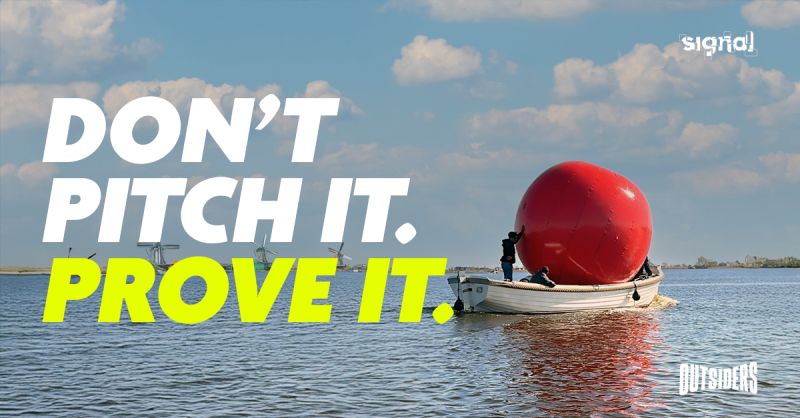
Having honed their development system, Signal.Stream is now offering this collaborative process to any producer with a format idea as part of a development package they’re calling “Outsiders”. Wouter explains how it works: “If you have some new IP that you genuinely believe in but are not yet at that stage that you want to ask for a big investment from a streamer or a linear partner, you can call Signal. We’ll take a look together at that new IP and see if there’s a way we can lo-fi it a little bit and make it tangible for our 2.5m YouTube viewers. See if they actually like the format”.
It’s a system that has already delivered one successful show, Let’s Play Ball, the Banijay format in which celebrities must guide gigantic inflatable balls across challenging terrain ranging from city streets to rugged countryside. A linear hit for SBS6 in August 2025, with a second season already ordered, the format has now been picked up by Crave in Canada, Finland’s Star Channel, with US and UK versions also in development. But without Signal.Stream’s involvement, Banijay might never have given the wacky premise a greenlight.
“They came to us with the decks and said ‘hey, this is something we really want to take out, but will it sustain for an episode?’ So we bought a ball, we ran it on YouTube, and 1.4 million people watched it. Then Talpa called, ‘wow, that’s a great show, we actually would love to have it’. Well, great, because together with the guys from Banijay we have this format, and right now, it’s travelling to multiple territories. That’s the aim, what we try and do. So we want to really open that new way of thinking to the whole industry, so everyone from a producer to a streamer to a broadcaster can call us up and say we have this amazing IP here, but before we invest a couple of million in making Series one, can you guys actually test it and see if we can make it stronger?”
“We’re all chasing the same goal, right?,” he continues. “We want to create that next world hit, because that’s our ego, our money, our whatever. Problem is that the biggest hits are often the things that don’t look anything like what’s on telly right now, which means that they’re a huge risk. And in the old model, that risk was fine, because you could commission 10 shows, five of them would do absolutely nothing, you throw them in a waste bin. Three of them would do good, and two of them outstanding, and those two outstanding ones would pay for all the rest. That model is not there anymore, because the advertising revenue dropped so much. No one can afford risk anymore.”
Using YouTube – and specifically StukTV’s built-in audience – is central to bringing back that ability to take risks. “We want to create a model where it’s actually okay to take that risk, because it’s not 10 million you’re spending, but 10,000. And then it becomes a whole different ballgame. An idea is never finished. You could get it to 60, 70%, and the last 30%, you’re only going to learn whether it works or not if you’re doing it. And that’s what YouTube really taught us. Just go out, have some fun, and just freaking do it. We were in those boardrooms, talking about ideas, and there’s no way we’re ever gonna get it right just by talking about it. There needs to be a point where we start to act.”
And crucially, for Wouter, acting doesn’t mean listening only to the C-suite. “We want to talk to the cleaning lady as much as we want to talk to the head commissioner at Fox, because no one actually knows where that next brilliant, sharp idea comes from”, he explains. “We would love to talk to everybody, because I don’t believe that I possess the skill to see, hey, that’s gonna be the next big thing, but I do know that we can build those things at such low cost, we can actually just do them all. And then we’ll know which one actually was that next big thing.”
 Dan Whitehead