
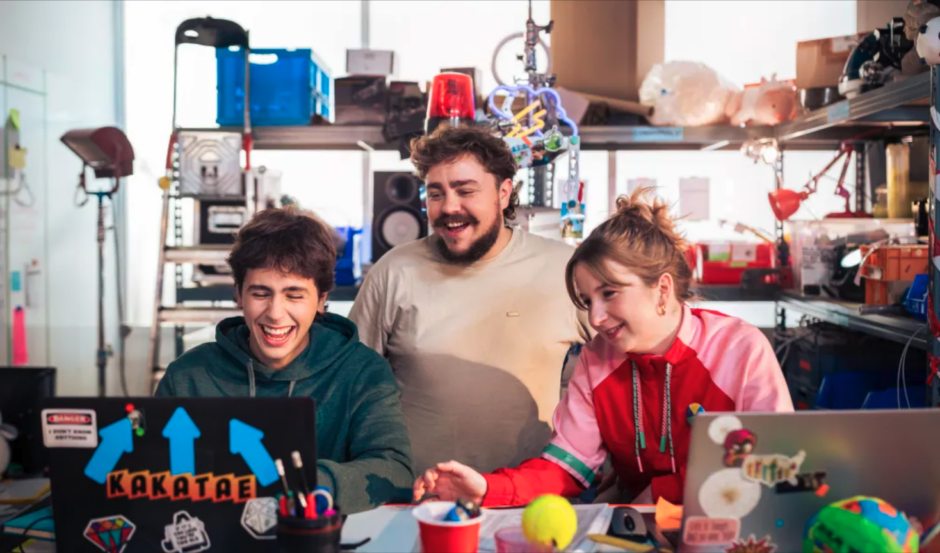
Pitched as “Call My Agent for the creator economy”, France Televisions’ new vertical shortform comedy Le Magasin (Tr: The Store) offers a compelling example of how traditional TV expertise can be leveraged to reach social-native young audiences. Set in the prop store of a content creator hub, the series follows new employees Jade and Enzo as they deal with requests from an array of content creators, all real French social media stars playing themselves.
The 22×3’ series released an episode every day across the Instagram, Snapchat, TikTok, and YouTube accounts of France Televisions’ Slash youth brand, with the entire series then collated on the broadcaster’s core france.tv streaming platform.
Produced by traditional film and TV studio Elephant, the original idea for the series was brought to CEO Sandra Ouaiss (pictured below) by Adrien Chabal and Mathieu Renard, two employees of Elephant’s parent company, Webedia. A veteran of Universal, Canal+, and Newen, Ouaiss is better known for traditional linear series such as crime drama Rebecca and spy thriller State of Alert, both for TF1, as well as family comedy Weekend Family for Disney+.

Chabal and Renard’s idea was inspired by their own experiences working with digital content creators, and had immediate appeal. “I liked their idea very much,” explains Ouaiss. “But I didn’t have in mind, specifically, the idea of doing it as a vertical series.”
Two writers were hired to develop the pitch into a series bible, both under 30 and both with experience working in the creator or youth TV spaces. Arthur Laloux was formerly an editor for McFly and Carlito, a famous French creator duo, while Queenie Tassel worked with Enya Baroux on Fleur Bleue for Canal+.
The push towards a vertical shortform series, rather than a traditional 16:9 sitcom, actually came from France Televisions, a legacy terrestrial broadcaster that was nonetheless keen to experiment more with scripted social video. France Televisions’ commitment to the vertical format even included the decision to drop the idea of shooting for widescreen at the same time. “We asked them if they wanted us to deliver a horizontal version as well. At the beginning they said, yes. But by the end they said, no, we’re really focusing on vertical. So we shot entirely vertical, delivered vertical, and really thought of the project as a vertical one.”
For Ouaiss and her writer’s room, composed of Boris Baroux (who also directed), Jérémy Barrière, and Arthur Laloux, the challenge was crafting episodes that felt unique to the featured content creator, without knowing which content creators would be available.
“That was the difficult part,” she admits, “Because you start to write, and you’re not sure yet if you will get this content creator. So you have to make a list of people who you think you can get, you have to take into account their character, the type of humour, and also tell them that you’re completely open to rewrite according to what they would like to do.”
Elephant’s corporate connection to digital media group Webedia helped with casting, allowing Elephant to quickly tap into the upper tiers of the French creator community. “We had some among our list of content creators who were part of Webedia, but not all of them. One of the guys who had the original idea, he knows a lot of content creators so he was also very helpful in going to them.”
Crucially, the creators taking part were all paid standard actor’s rates. “It was not a lot of money compared to what they could earn doing commercial sponsorships”, Ouaiss explains. “The idea that we sold to them is that it’s a different experience. They’re playing themselves, but they still have to act. Some of them were interested in becoming actors. For others, I would say it was the fun of doing something different.”

A particularly good example of how the chance to subvert their public persona was a draw for top digital talent is Gaspard G (pictured above), a 28-year-old YouTuber who has amassed 1.7m subscribers with his serious factual and news-based content. “In his episode, he decides he doesn’t want to do informative videos anymore. That was the idea.” Ouaiss recalls. “But he wanted us to push the envelope. He said, no, no, I should come in like a punk, dressed like a metal musician.” For popular creator EnjoyPhoenix, a storyline about her trying to avoid a persistent entrepreneur who wants to collaborate was the most fun.
Not every script or creator worked out as planned. “In this way of working, you have to be able to change because sometimes we wrote episodes and didn’t manage to get the content creator. You have to be flexible. Sometimes we were able to reuse stories or modify them, sometimes we were forced to throw out ideas.”
The actual filming was fast, shooting four episodes per day in one production block of just over a week. The need to schedule four content creators to be on set each day was its own challenge. “We sent emails to the content creators and their agents telling them, okay, this is the window that we have, what will be your availability within that window? It’s kind of like a puzzle. Okay, let’s put him in the afternoon, and so on. I don’t know how, but it worked. We managed to get them all.”
The turnaround from pitch to delivery of the entire 22 episode first season was just seven months. The single location was a key part of this agile production. “One of the questions when we prepped was are we going to shoot in an external studio, or shall we use Webedia’s own offices?” Ouaiss explains. “One third of the content creators were Webedia clients. Even the ones who aren’t, they know the company, they’ve been here before, so we decided to shoot at Webedia. That was easier for us.”
As for the future, the Elephant team is waiting to hear back regarding the performance of the series on france.tv for a potential second season, but production can be ramped back up quickly. With the writing team in place, and the location fixed, the big task for future instalments will be casting related. “If we want to work with the most popular creators, at some point we need to come back to people we already used. We also explored a lot of situations already, so there is also a challenge of not repeating our scenarios.”
There’s also the possibility of licensing the format – an option that has yet to be fully tested with shortform vertical drama in Europe. “It was not our first priority to explore the international market,” Ouaiss says, “But yes, it’s a format that we would like to take advantage of in other countries. It’s very formatable. It’s easy to do everywhere. The format belongs to us, so we’re happy to discuss remakes.”
 Dan Whitehead